Adaptive Ray Marching for Rendering
Gaussian Process Implicit Surfaces
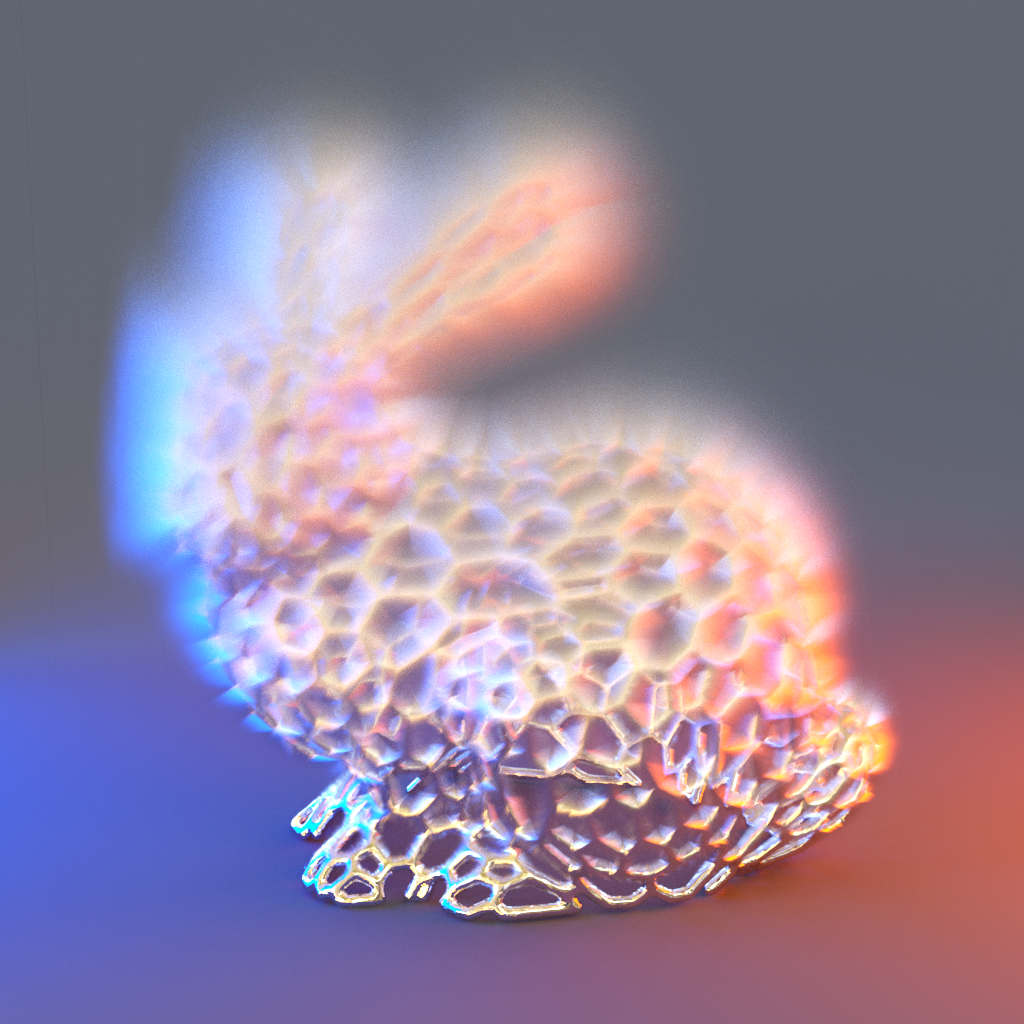
A 46× reduction in rendering MSE at equal time for Gaussian Process Implicit Surfaces, via online GP sampling and probabilistic adaptive ray marching.
Abstract
Gaussian Process Implicit Surfaces (GPIS) represent geometry as a distribution over implicit functions. Modeling an object's appearance as the expected rendering of a GPIS yields a unified framework that captures diverse light-transport effects including microfacet-like reflections and volumetric scattering. Despite this generality, computing GPIS-ray intersections requires sampling conditional multivariate Gaussian distributions along each ray and remains prohibitively expensive.
We introduce an online sampling algorithm that draws these distributions incrementally, and an adaptive marching scheme that takes large steps where the surface is provably absent — minimizing the probability of missed intersections. Together, these ideas reduce rendering MSE by up to 46× at equal time compared to existing methods.
Method
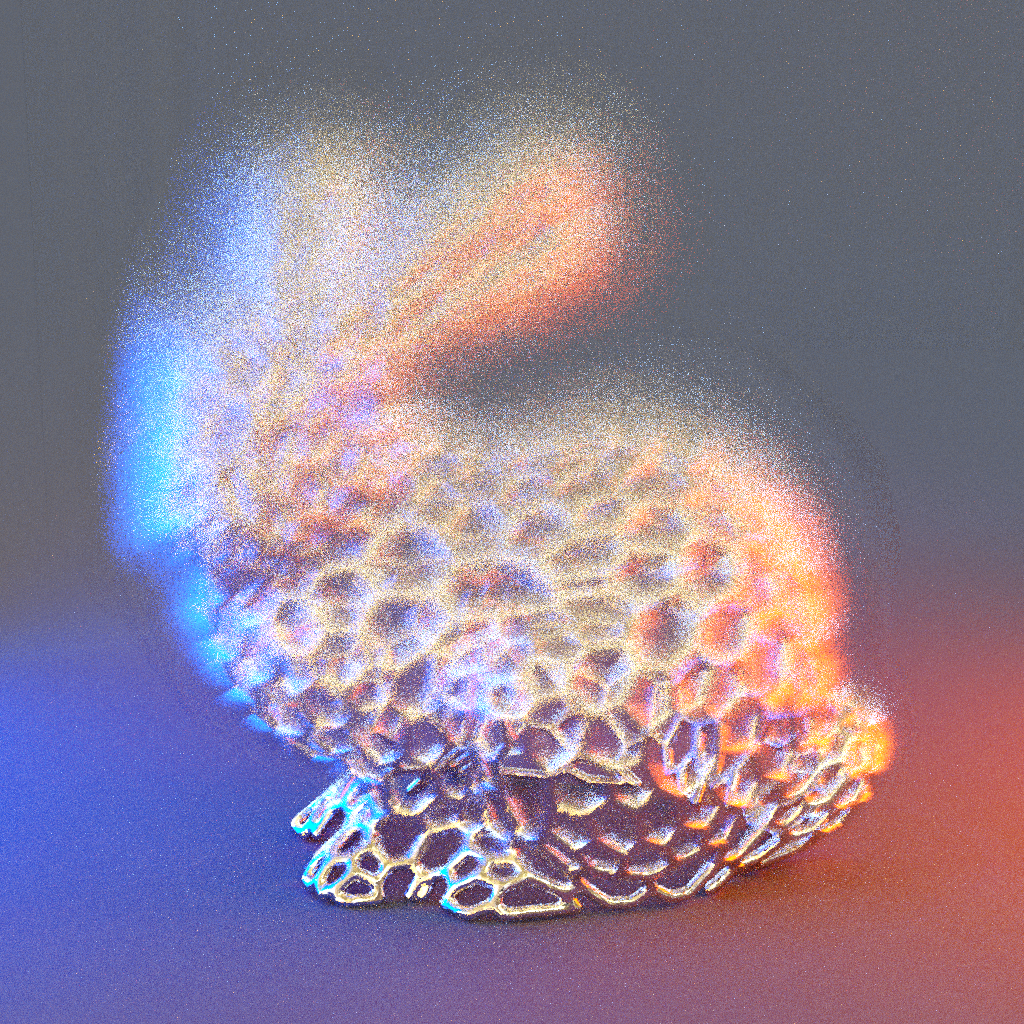
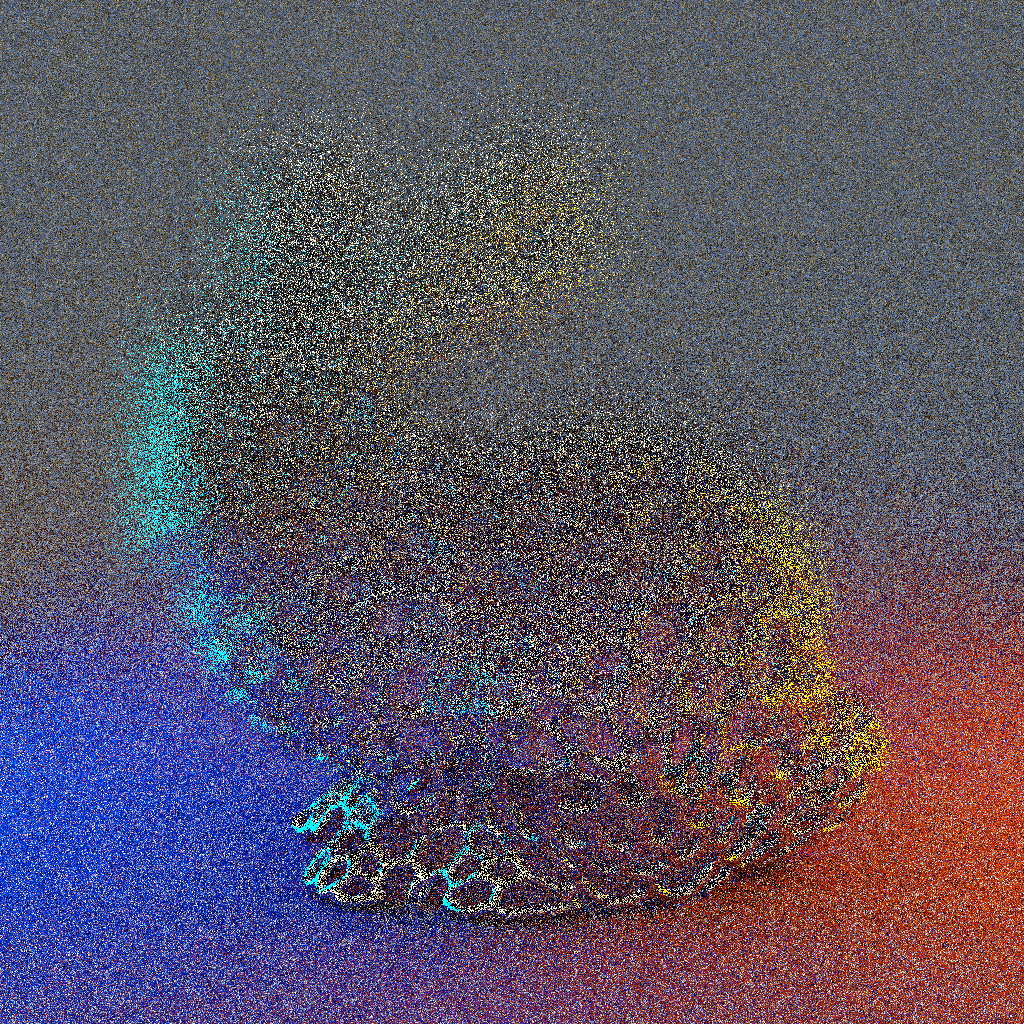
We address the bottleneck of GPIS-ray intersection, by marching along the ray with adaptive step sizes, sampling the Gaussian process incrementally until a sign change in $f$ brackets a zero crossing. An online sampler produces each new value $f(t_i)$ on the fly. The step size $t_{i+1} - t_i$ is then determined automatically so that the probability of skipping over a root stays below a small tolerance. At equal or higher accuracy, the marcher uses far fewer GP samples than the baseline, and reduces computation by about a cubic factor.
Baseline — uniform grid
Ours — adaptive marching
BibTeX
@inproceedings{zhou2026adaptive,
  title     = {Adaptive Ray Marching for Rendering Gaussian Process Implicit Surfaces},
  author    = {Zhou, Zhiqian and Seyb, Dario and Zhao, Shuang},
  booktitle = {SIGGRAPH 2026 Conference Papers},
  year      = {2026},
  publisher = {ACM},
  address   = {Los Angeles, CA, USA},
  doi       = {10.1145/3799902.3811101}
}